New year — new e-fleet management?
Start the new year with new ideas about fleet management — where are real cost savings hidden?
The electrification of fleets is no longer an issue of the future. Many companies are already in the thick of it: E-vehicles have been ordered, charging cards have been distributed, and initial experience has been gained. And yet, for many fleet managers, one key question remains unanswered: Are we really in control of our overall costs or are we just feeling good about it?
When it comes to charging, it's easy to see that the decisive factor is not just where charging is carried out, but at what prices — and how well these costs can be planned.
Fleet without home charging: a manageable concept, a complex life
Companies without a home charging solution usually end up with a similar setup:
- Charging at the company location (work charging), if available
- Charging on the go at public stations
On paper, it sounds clearly structured. In practice, however, the charging data shows a different picture, especially when it comes to the subject Cost variance.
Work charging: relatively stable, easy to plan
For medium-sized companies, the price of electricity in business is often within a clearly defined range. An example from the analysis: The median price of a typical business tariff is around Rp 25. /kWh (C3, Elcom), with a range of approx. 8.5 to 40.9 Rp. /kWh
For female fleet managers, this means: manageable fluctuations, reliable calculation.
Public charging: large bandwidth, low predictability
The situation is completely different when it comes to public shops. Here, the data show a significantly higher price variance: from 0.28 CHF/kWh to over 1.00 CHF/kWh and more. This range is not an outlier, but everyday life — regardless of provider, location, charging capacity and time.
But that's not all: When it comes to public charging, the kWh price is often not the only cost factor.
Depending on the station and tariff, the following may also apply:
- Time charges (e.g. per minute after a certain downtime or from the start
- Fair use fees when vehicles stay connected “too long”
- Starting fees, regardless of the amount of energy charged
The result: Two charging processes with a similar kWh volume can result in completely different total costs in the end, simply due to the tariff structure.
For female fleet managers, this means:
- The total cost of charging can hardly be estimated in advance
- Costs fluctuate not only because of the price of electricity, but also because of additional charges
- A clean comparability between vehicles, drivers or months is significantly more difficult
predictability? Barely given.
Especially in fleets with a high proportion of public charging processes, this creates a cost reality that is difficult to predict.
What our data also shows: If you don't have home charging, you charge publicly more often
Particularly exciting: Drivers without a home charging station charge more publicly than in stores, where charging is cheaper.
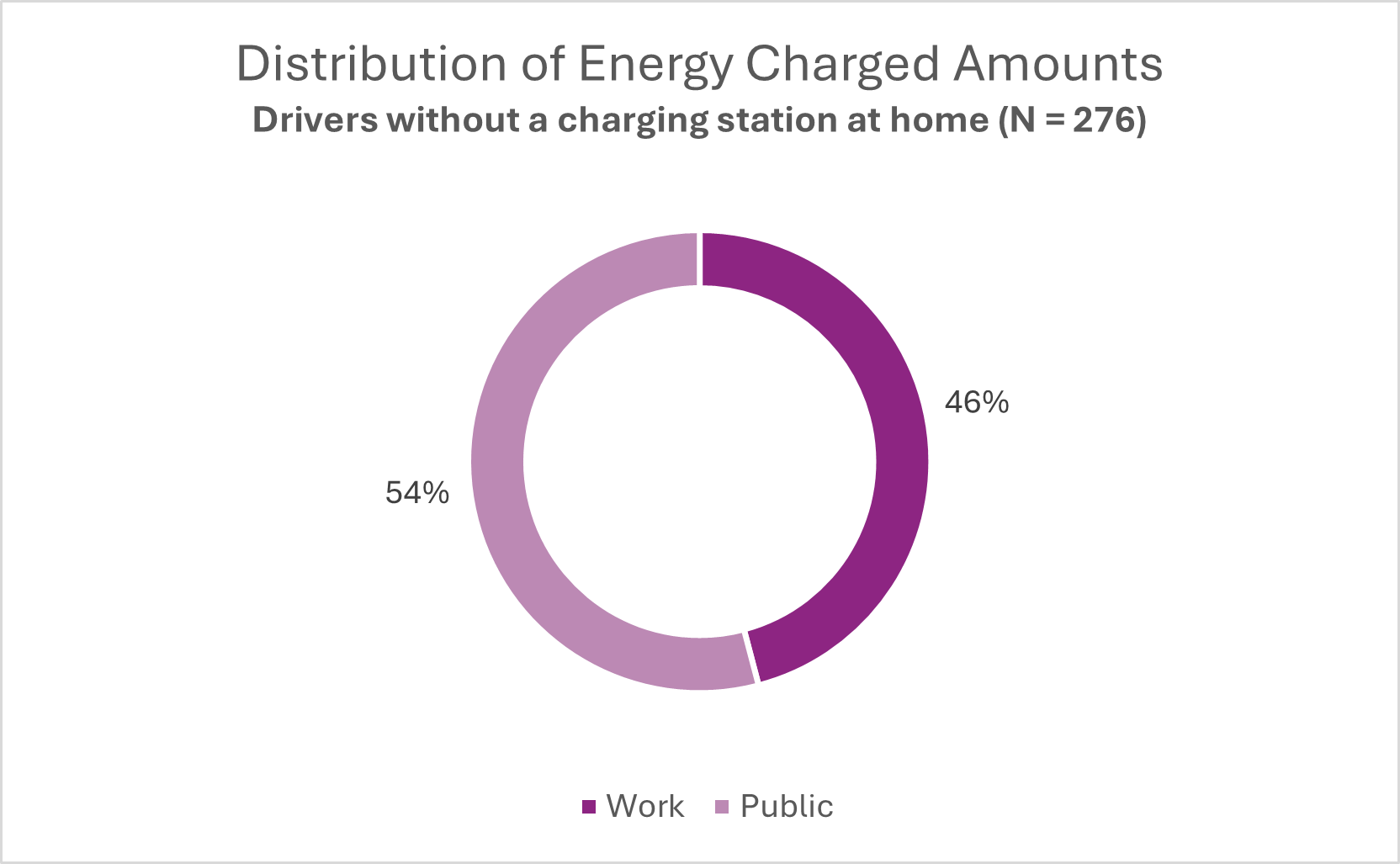
That means:
- More charging on the go
- More price variance and more price uncertainty
- More different statements
Especially among employees working in the field or with longer commuting distances, it is clear that a large part of the energy does not flow at the company location, but where prices fluctuate the most.
For fleet managers, this not only increases overall costs, but above all the unpredictability of overall costs.
Fleet with home charging: the full picture of costs
With home charging — and a clean solution like ChargeHome — the perspective is shifting. Because suddenly the charging location with the greatest potential is also included in the bill: the employees' homes.
What's changing as a result:
- Cheaper and more stable energy prices compared to public charging
- Significantly lower price variance than with public charging
- Fewer public charging processes, fewer detours, less loss of time.
And above all: The total costs of the fleet are really visible for the first time.
Transparency instead of gut feeling — real added value for fleet managers
The biggest benefit of ChargeHome lies not only in the lower electricity price, but also in the transparent total cost statement:
- Exact recording of the charged kWh at home
- Fair, consumption-based compensation to employees
- Clear, comprehensible costs per vehicle and per driver
No flat rates, no Excel lists, no discussions at the end of the month. Instead, a clean data base that fleet managers can work with — and that is also convincing internally, for example in finance, controlling or management.
Conclusion: If you want to save money, you have to think holistically
Fleets without home charging often pay more than they expect — not necessarily because of high electricity prices, but because of a lack of predictability, high price variance and lack of transparency. At first glance, public charging appears flexible and uncomplicated, but in practice it eludes reliable cost management.
Fleets with home charging and a solution such as ChargeHome, on the other hand, gain decisive control:
- Transparency across all charging locations
- predictability of energy prices, infrastructure and billing
- Comparability between vehicles, drivers and time periods
- Acceptance among employees through fair, consumption-based compensation
This turns e-fleet management from gut feeling into a reliable basis for decision-making — for fleet management, finance and executive management.
Outlook: “But charging infrastructure is so expensive” — is that really true?
A common counterargument remains: “But charging infrastructure for all employees costs a fortune.” We'll take a closer look in the next blog post.
We analyze:
- What additional costs actually arise from charging infrastructure at home and at work
- Why these costs are often overestimated
- And why a fleet travels cheaper even when every employee has their own charging station.


