For many e-car drivers, charging at home is the most convenient and at the same time cheapest way to supply their vehicle. But in everyday life, people underestimate the exact potential of this charging location — for drivers, companies and entire fleets.
Our data shows that home charging is not just a convenience factor, but one of the central components of a cost-efficient, fair and sustainably operated e-mobility strategy. In this blog, we look at how much energy is charged at home, why electricity prices have little influence on charging behavior and why package solutions create systematic inequities in the long term.
How much is charged at home? Focus on the amount of energy
To better understand actual charging habits, we look at the average amount of energy charged at home per driver — regardless of the individual electricity price.
The evaluation of 273 fleet drivers over three months shows a very heterogeneous usage:
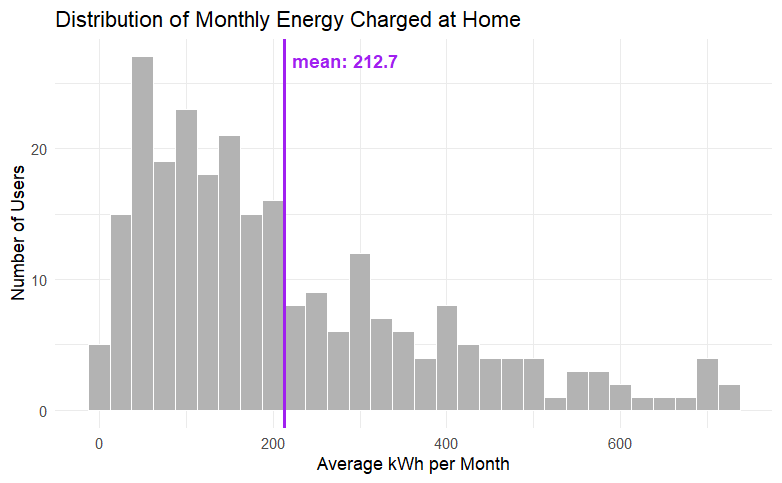
- The average driver loads 212 kWh per month at home.
- The distribution is extremely heterogeneous: Many charge rather little, while a few charge very high amounts of energy at home.
- A large part is below 150 kWh per month while the top 10% over 400 kWh achieve per month.
But what really drives this behavior?
Habit beats electricity prices: The true driver of charging behavior
A key question is: Does a high energy price at home mean that less is charged?
Our data clearly shows: No.
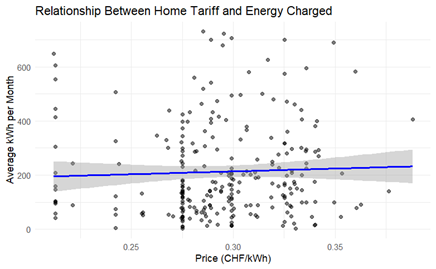
The analysis of the monthly amount of energy charged in relation to the individual home tariff shows no discernible connection. Drivers with high energy tariffs don't charge less, and drivers with low tariffs don't charge anymore. The spread remains virtually the same across all price levels.
The observation makes it clear that price hardly plays a role for drivers when it comes to home charging.
For many drivers, the pattern is extremely simple and deeply rooted: “I come home, plug in and load.”
This intuitive behavior can also be achieved with data evidence. The analysis of charge states (State of Charge, SOC) At the start and end of charging processes, there is an extremely consistent picture that confirms this habitual pattern.
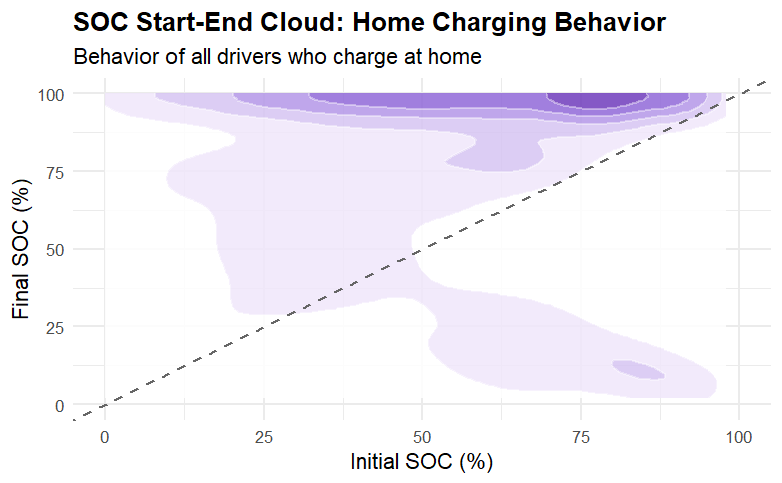
The evaluations of all home loads show a central pattern: Charging processes often start with a relatively high SOC
A large proportion of drivers start charging at an SOC of 40-60%. This means that there is no wait until the battery is largely empty — it is often plugged in much earlier.
This behavior is in line with what we mentioned “Safety charging”:
- Drivers want safe enough range for the next day
- You'd rather charge earlier than necessary — not out of rationality, but out of a sense of comfort and security
- Range anxiety plays a role, but also pure routine.
In contrast to charging stations at work, “safety charging” at home does not lead to infrastructure bottlenecks. The private charging station belongs to the drivers themselves; no one else is usually dependent on it.
These analyses lead to a clear conclusion: Home charging is driven by habit and mobility patterns, not by the price of electricity.
For fleets, this means:
- Users load routinely, not after more economic optimization
- Fairness models must reflect real behavior, not theoretical pricing logics
Why fair reimbursement is not trivial — and flat rates always fail
At first glance, refunding home charges seems simple: electricity costs x consumption = done.
But as soon as companies try to implement this approach fairly and uniformly for many drivers, it becomes apparent that there are huge differences behind the uniformity of “home charging” — and it is precisely these that make compensation models highly complex.
Three factors shape this diversity:
Factor 1: No one charges the same — consumption is extremely different
In the fleet, there is an employee who charges barely 80 kWh per month at home because he has short distances. And there is the frequent commuter who regularly needs over 400 kWh due to long commutes. There are dozens of individual profiles in between — 120 kWh, 210 kWh, 650 kWh.
The reality is: The load volumes differ by a factor of 5 to 10.
Factor 2: Electricity prices differ massively — no average assumption is true
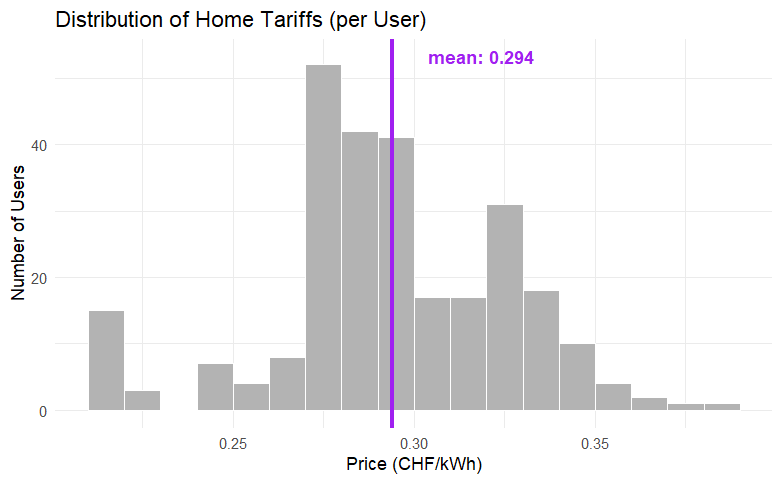
Although the average home rate is 0.29 CHF/kWh, the regional spread is enormous:
- Some regions charge very cheaply.
- Others — such as in Tessin or in Eastern Switzerland — are significantly higher.
A fixed price per kWh therefore necessarily leads to distortions:
- Drivers in expensive regions are underpaid.
- Drivers in favourable regions are overpaid.
Factor 3: Additional costs such as parking or infrastructure fees
In addition to pure electricity costs, apartment buildings with rental apartments in particular incur additional monthly fees for the charging parking space or the necessary infrastructure — often between 30-50 CHF per month. Many companies assume these additional costs for their employees.
Drivers pay an average of 30-50 CHF per month for the charging park or infrastructure — others do not.
Why flat rate models collapse in this reality
Many companies are considering flat rate solutions (fixed price per kWh or monthly fixed amount) to make reimbursement easier. At first glance, packages seem convenient. But because they did not take into account any of the real differences, they always lead to over- and undercompensation.
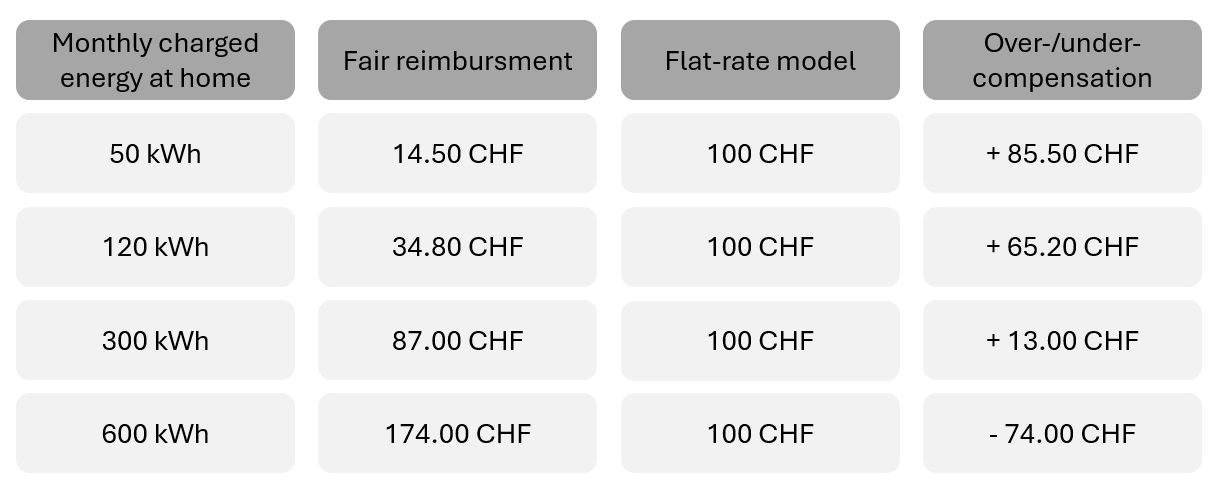
This pattern does not arise from errors in the system, but from the nature of the lump sum itself: It smoothes out differences that are in fact huge.
Stay cheaper at home — even with additional costs
Nevertheless, charging at home almost always remains significantly cheaper in practice than charging at public stations. Because even if you include the monthly parking fee, the price advantage clearly remains. This is also shown by a simple calculation example:
- Driver charges 200 kWh per month
- The electricity price in the village is 0.28 CHF/kWh
- Monthly parking/infrastructure costs are 50 CHF
- Total costs: 200 × 0.28 CHF = 56 CHF + 50CHF = 106 CHF
If the drivers had uploaded this publicly:
- If the average price of kWh at public stations is 0.60 CHF/kWh
- Total costs: 200 × 0.60 CHF = 120 CHF
Even with an additional cost of 50 CHF, home charging is still cheaper. In this example, the user continues to save 14 CHF per month — a significant saving for large fleets!
Conclusion: Fairness only comes from individuality
A usage-based refund with the actual electricity tariff — as ChargeHome calculates it — is more transparent, fairer and reflects the diversity of real charging patterns.
ChargeHome solves key challenges for many companies:
- No more packages
- No estimated averages
- No admin mountains with Excel lists
- No conflicts between drivers and fleet management
The combination of real vehicle data, precise kWh recording and automated billing makes home charging from a “sideshow” a real efficiency and cost driver.
For companies, this means less effort, more fairness, more transparency — and a solution that works for both drivers and fleets.