
The electrification of corporate fleets is no longer a vision of the future. Many companies have already introduced electric vehicles and gained initial experience. But one crucial question often remains unanswered: Is investing in charging infrastructure at home worthwhile for employees or is public charging or charging at work sufficient?
At first glance, the investment costs seem high. One charging station per employee quickly means several thousand francs per vehicle. However, our analysis shows a different picture: Over time, charging at home is not only more convenient, but also has a clear economic advantage.
Charging at home vs. charging publicly: Two completely different cost worlds
In our previous article, we already talked about the price volatility of public charging stations. Here is a short summary again.
At home:
- Average cost: approx. 0.30 CHF/kWh
- High predictability
- Hardly any price volatility
Public charging:
- 0.28 CHF/kWh up to over 1.00 CHF/kWh
- Massive price range
- Depending on provider, location, charging capacity and time
- Low predictability
-
This price range for public shops is not an outlier — it is part of everyday life. This volatility not only makes budget planning difficult, but also leads to significantly higher overall costs in the long term.
Charging behavior is massively changing the cost structure
Just as important as the price itself is the question of where you actually charge. As soon as employees get their own charging station at home, charging behavior changes significantly.
Previous analyses show the following charging patterns:
With a charging station at home:
- 69% Home
- 19% Work
- 12% Public
At home without a charging station:
- 54% Public
- 46% Work
This shift will have a direct impact on the cost structure and this is exactly where the decisive lever lies.
A direct comparison of two fleets
To make this effect tangible, let's look at two identical fleets of 50 vehicles each — calculated using the example of a Škoda Enyaq with an annual mileage of 20,000 kilometers per vehicle.
Fleet A is optimised: All employees have their own charging station at home.
Fleet B, on the other hand, is not optimised: There is no home charging solution; charging is mainly carried out publicly or at the company location. The difference between the two fleets therefore lies exclusively in the charging infrastructure — not in the vehicles or their use.
A driver in the optimised fleet charges the majority of his energy requirements at home or at work. Around 88 percent of charging processes take place there, at an average cost of around 0.32 CHF per kWh. Public charging stations account for only a small share of 12 percent. This results in annual charging costs of around 1,698 CHF.
A driver of the unoptimized fleet, on the other hand, is significantly more reliant on public charging points, as no home charging station is available. Its annual charging costs are correspondingly higher: They amount to around 2,490 CHF per year.
The cost trend over 5 years
Installing home charging stations initially requires a noticeable initial investment. With a fleet of 50 vehicles, this quickly adds up to a six-figure sum.
As an example, the following simulation looks at one driver per fleet. Fleet A starts with higher initial costs due to the investment of around 2,000 CHF per home charging station — assuming that in practice, companies usually do not cover the full installation costs (approx. 3,500 CHF). In fact, we see subsidies ranging from 1,000 to 2,000 CHF per employee for many company fleets. The simulation is therefore based on a realistic experience value of 2,000 CHF.
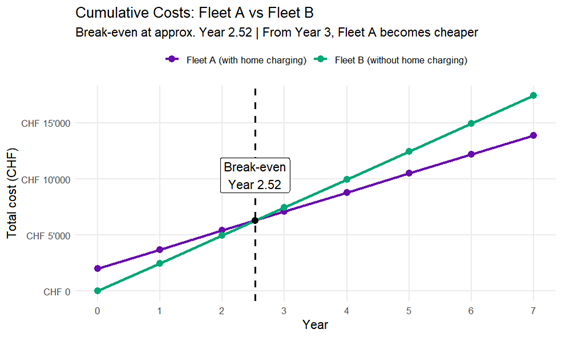
With regard to ongoing energy costs, however, a clear trend quickly emerges. Due to the high proportion of home and business loads, the optimised Fleet A significantly reduces its operating costs and makes up for the initial cost disadvantage year after year.
After a few years, the cumulative total costs of the fleet with a home charging station fall below those of the fleet without the appropriate infrastructure. The illustration visualizes this process and the time of amortization. Starting at around 2.52 years of age, each additional operating period results in a financial advantage for the company.
Why the investment pays off
The economic advantage results from several interacting effects. Expensive public charging processes are being reduced, while cheap and stable home charging rates dominate. At the same time, the predictability of energy costs increases significantly, which is a strategic advantage, particularly for large fleets.
There are also operational effects: Employees save time because they do not have to actively search for charging stations and satisfaction increases due to the convenience of charging at home. Optimization therefore means not only reducing costs, but also increasing efficiency.
A strategic investment instead of additional costs
What initially seems like a large expenditure turns out to be a strategic investment in the long term. Fleets with home charging infrastructure benefit from lower overall costs, greater planning security and more efficient processes.
The real question is therefore no longer whether home charging stations are worthwhile, but how quickly companies want to benefit from this optimization.
New: ROI calculator for your fleet
Would you also like to know how much you can save? With our ROI calculator, you can save costs and reduce CO₂ when switching to electric mobility with our intelligent charging solutions.
With the ROI calculator, you can calculate your savings using the following data:
- number of vehicles
- Share Home/Work/Public
- investment costs