
The moment every fleet manager knows
7:30 AM. The office parking lot fills up. Employees arrive, get out, and plug in their electric vehicles. A perfectly normal start to the day, and precisely where the problem begins.
Because all vehicles charge simultaneously. Exactly when electricity demand and prices are highest. This remains invisible to drivers. For the company, it becomes expensive.
What looks like efficiency is, in reality, an uncoordinated peak load – every single morning.
The real problem: Energy & Mobility don't speak the same language
Mobility follows the daily work routine. Energy follows supply, demand, and grid load. And this is precisely where the gap arises.
While vehicles charge exactly when they arrive, electricity is scarce and expensive during these times. At the same time, there would be sufficient capacity throughout the day or at night, and it would be significantly cheaper, more stable, and more efficient. But these time windows remain unused.
And this is precisely the fallacy: companies today optimize their fleet – but not its energy behavior.
It's not about whether charging happens. But when.
And this "when" makes the difference between a cost factor and a competitive advantage.
What if your fleet didn't just charge as soon as a vehicle is plugged in, but precisely when it's most economically and energetically sensible? This is exactly where chargeSmart comes in.
chargeSmart brings both worlds together
Instead of relying on the randomness of the daily work routine, chargeSmart for the first time connects what was previously separate: mobility and energy.
Imagine your vehicles had an intelligent assistant in the background. One that knows exactly when a vehicle truly needs energy and when it doesn't.
That's exactly what chargeSmart is. It's not a charging station, but software that makes your existing charging infrastructure smarter – automatically, in the background, and without any extra effort for your drivers.
How chargeSmart works – simply explained
Smart charging often sounds complex, but it's based on a simple principle: Not every vehicle needs to charge immediately. What's crucial is when the energy is actually needed.
In the background, the software continuously analyzes your fleet's situation: when vehicles arrive, how much energy they need, and when they must be back in operation. This reveals a central element: available flexibility. Because in most cases, vehicles remain plugged in longer than they actually need to charge.
chargeSmart specifically utilizes this leeway.
Instead of starting the charging process immediately, charging sessions are deliberately shifted to time windows when electricity is cheaper and the grid is less strained. Typically, these are hours outside of classic peak loads, such as at night or during phases of high energy availability with high solar production.
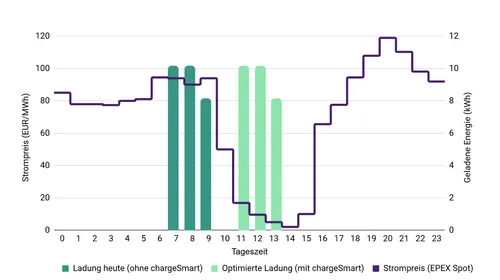
In the background, chargeSmart combines various data sources:
- The individual charging behavior of the vehicles
- Typical locations and charging points
- As well as electricity price information for the coming hours.
Based on this, chargeSmart automatically plans and controls charging processes. Vehicles no longer charge upon arrival, but at the most economically sensible time.
A crucial difference from other solutions lies in the type of control: namely, via the vehicle and its battery, not via the charging station.
Specifically, this means:
- Charging processes can be started, paused, or shifted independently of the infrastructure
- No dependence on specific charging points or electricity meters
- Uniform control across different locations.
In contrast, classic dynamic load management is limited to distributing available power within a building to prevent overloads. chargeSmart goes a crucial step further: it actively shifts the charging process itself into more favorable time windows, thereby optimizing not only the infrastructure but, above all, energy procurement.
Currently, this control is unidirectional, meaning electricity flows specifically into the vehicles at the optimal time. With future developments like Vehicle-to-Grid (V2G), this principle can be further expanded. Vehicles could then store energy and feed it back into the grid when needed (bi-directional charging), creating additional economic potential.
Further Use Cases: How chargeSmart works in practice
Besides the classic morning rush at the office, there are numerous other situations where chargeSmart can unleash its full potential.
Depot/Logistics – Evening Return
In logistics or service fleets, vehicles typically return to the depot in the late afternoon or evening. Without smart control, they immediately begin charging – precisely during the phase when general electricity demand rises sharply, as many households simultaneously cook, use appliances, and draw power.
chargeSmart recognizes that the vehicles won't be needed again until the next morning. The charging process is therefore deliberately delayed and shifted to the night, when demand decreases and electricity is significantly cheaper.
Vehicles charge automatically overnight, without manual intervention, and are fully ready for use the next morning.
The effect:
- Shifting energy consumption to inexpensive night hours
- Significant reduction in electricity costs
- Relief for the power grid during critical times
This creates a direct financial advantage for companies, without impacting fleet readiness.
Small Business with PV System – Optimally Utilizing Own Energy
For smaller businesses with their own photovoltaic system, there's particular potential in utilizing self-generated electricity. However, without smart control, this is often not optimally used, as vehicles charge during times when there is no or only low solar production.
chargeSmart recognizes this dynamic and specifically shifts charging processes to time windows with high solar production – typically around midday. Vehicles thus preferentially charge when their own electricity is available.
The effect:
- Maximizing self-consumption
- Reducing reliance on expensive grid electricity
- Improved economic efficiency of the PV system
For the company, this means greater independence from the energy market and significantly more efficient use of its own resources.
Business Impact: What does this mean in practice?
For companies and fleet managers, it all comes down to one simple question: Is it economically worthwhile?
The short answer: Yes, and it already is today. With additional upside potential.
Measurable Savings – with further optimization potential
To illustrate the effect of chargeSmart, the charging behavior of a real customer was analyzed and compared across three different scenarios:
- Naive: Charging starts immediately upon plugging in
- Balanced (chargeSmart): Smart control based on behavior and price forecasts
- Optimal: Charging exclusively during the most favorable time windows
The result of this case study:
- chargeSmart already reduces energy costs by approximately 3% compared to naive charging
- At the same time, there is an additional potential of about 7% to reach the theoretical optimum.
- The total optimization potential is therefore around 10%.
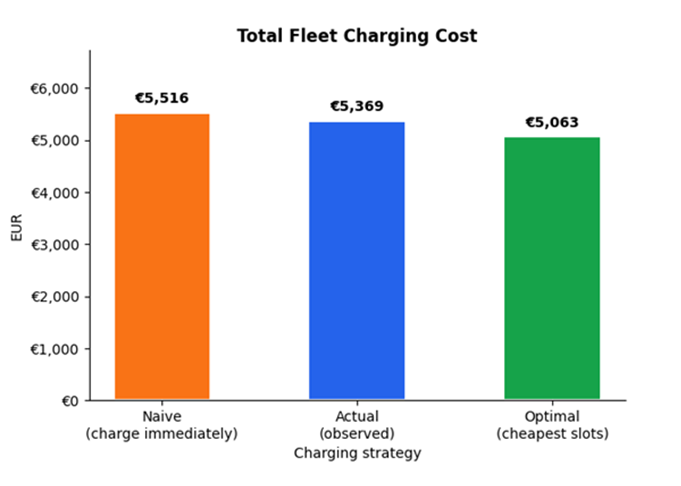
Important context: The analysis is currently based on the first two winter months. As electricity prices and, in particular, the availability of favorable time windows change in spring and summer, we expect the savings potential to further improve in the coming months.
Why this is more than it sounds
At first glance, 3% savings might seem modest. In reality, however, they are highly significant. This is because these savings are achieved entirely without any behavioral changes from drivers, without any loss of efficiency for the driver, and equally crucially, without additional effort or investment in charging infrastructure. Since chargeSmart controls directly via the vehicle, no adjustments to existing charging stations or installations are necessary.
At the same time, the savings apply to every single charging session and scale automatically with the size of the fleet. This means it's not a one-time optimization, but a continuously effective lever that unfolds further with each use.
Even more crucial, however, is looking at the remaining potential: The gap to the theoretical optimum clearly shows that chargeSmart is not a static system but is continuously evolving. A portion of the savings is already being realized today, while an additional portion represents a planned upside in further development.
The crucial lever: Downtime = Money
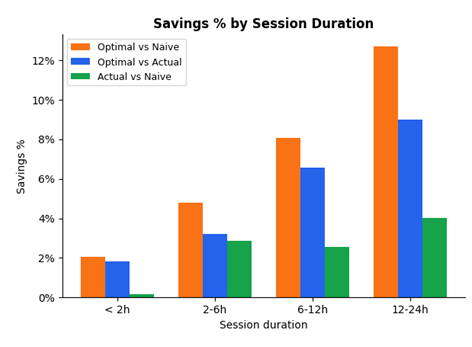
The analysis also shows: The longer vehicles are plugged in, the higher the savings.
Specifically, this means:
- Office fleets with long downtimes → consistently stable savings
- Depot and logistics fleets → high optimization potential overnight
- Mixed fleets → automatic utilization of existing flexibility
Electromobility is growing rapidly, and at the same time, the strain on power grids is increasing. Smart charging is thus no longer a luxury, but a necessity. Because with increasing electrification, a central question fundamentally changes: no longer just where charging happens, but above all, when.
Today, many charging processes start exactly when vehicles arrive – in the morning at the office, in the evening at home, or simultaneously at the depot. However, electricity demand is often already high at precisely these times. This leads to peak loads, higher energy costs, and additional strain on the grid infrastructure.
The future of electromobility therefore lies in intelligent temporal control. Vehicles no longer simply charge immediately, but specifically during time windows when electricity is cheaper and more readily available – without restricting mobility.
Fleets thus become an active part of the energy system. They can shift loads, relieve power grids, and optimize energy costs. A simple charging process thereby transforms into an intelligent energy decision, with benefits for companies, drivers, and the entire energy system.
Together towards an intelligent energy future
The development of chargeSmart shows how closely electromobility and the energy system will grow together in the future. Intelligent control of charging processes will thus become a central building block for a stable, efficient, and economical energy system.
The chargeSmart project is part of the program "Ladenpunkt" supported by the Swiss Federal Office of Energy. The program promotes practical solutions that advance the expansion and intelligent use of charging infrastructure for electromobility in Switzerland.


